
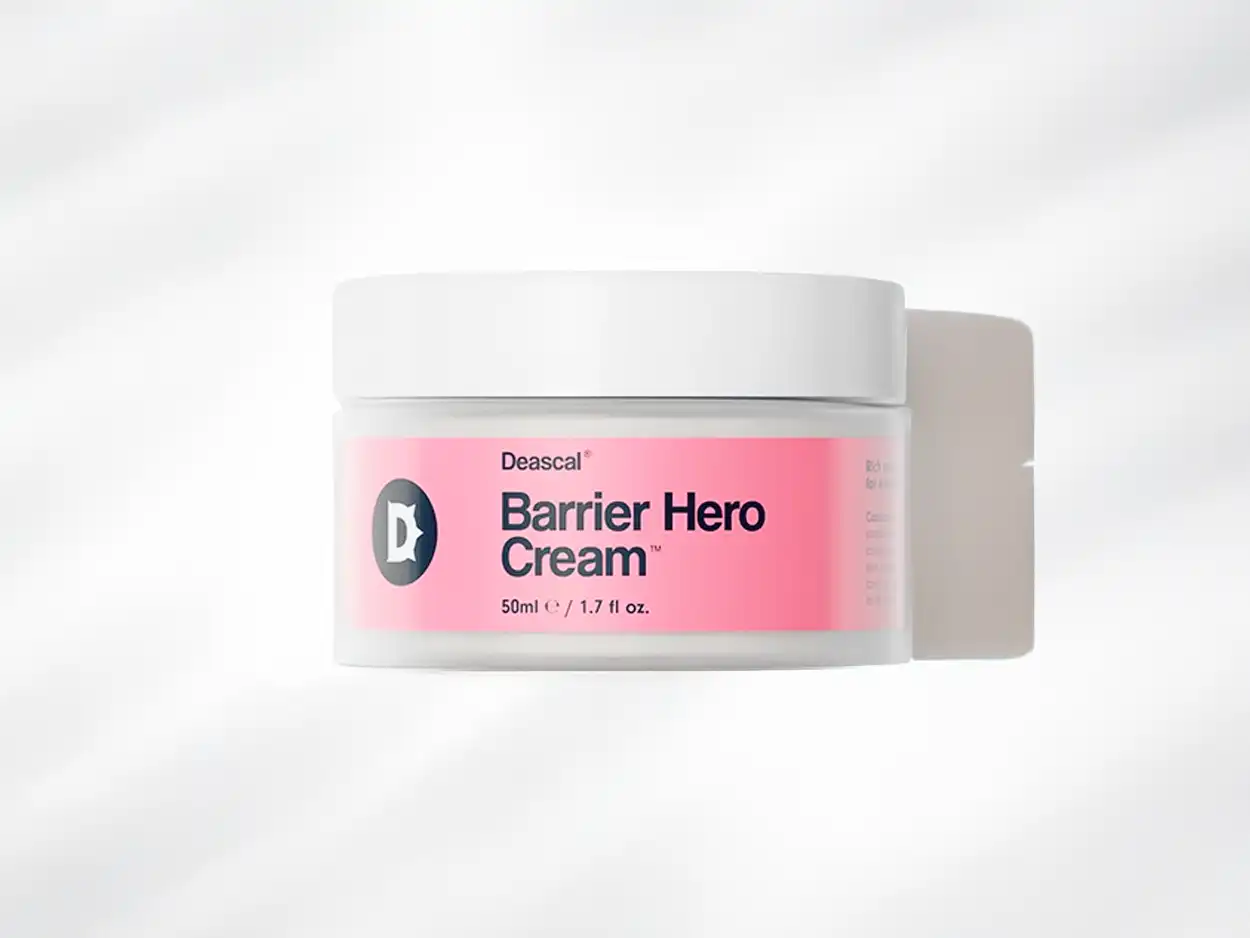

Deascal is not yet a household name, but it has quickly earned a reputation among skincare insiders for formulas that feel more dermatologist white coat than marketing department. There is a quiet confidence to the brand, the kind that suggests it is more interested in what is happening in your skin barrier than on your social feed, and that alone already sets it apart.
With Barrier Hero Cream, Deascal has given its latest launch a name that sounds like it should arrive with a cape, which is a touch dramatic for a moisturiser, but also fairly on brand for the current era of barrier-obsessed skincare. Officially, it is positioned as a rich restorative face cream for all ages and all skin types, made in the UK, promising to support and repair the skin’s barrier, keep moisture locked in for 24 hours, calm redness and ultimately deliver fuller, firmer, better-protected skin. It is billed as a market-leading barrier repair cream powered by something called Barrier Enhancement Technology, packed with heavy-hitting actives like hyaluronic acid, glycerin, ceramides and squalane that are meant to work at multiple levels of the skin.
In an industry crowded with big claims, social media hype and under-dosed formulas, it is only sensible to be cautious, which is exactly why I spent 4 weeks using Barrier Hero Cream consistently to see how well it really performs and whether it earns a place in a routine that respects both your skin and your wallet.
What is Barrier Hero Cream?
Barrier Hero Cream is Deascal’s take on a barrier repair cream, which is essentially a moisturiser designed to do more than just sit on the surface and feel hydrating. Barrier repair creams are formulated to support the skin’s natural protective layer, often called the barrier, which helps keep moisture in and irritants out. When that barrier is damaged, skin can feel tight, dry, sore or look red and reactive. Products in this category aim to strengthen that barrier, reduce discomfort and help skin function more normally again.
This particular formula is described as a rich restorative face cream suitable for all skin types and all ages, and it is made in the UK. In practical terms, it is meant to work for people with dry, oily, combination or sensitive skin, and to slot into a routine whether you are dealing with early fine lines or more established signs of ageing. The focus is less on chasing a specific age bracket and more on getting the barrier into a healthier place so that everything else you use has a better chance of working well.
Deascal positions Barrier Hero Cream as a product that supports and reinforces the skin’s barrier, repairs existing damage and protects the skin so that it appears younger, fuller and firmer over time. It is also meant to lock in moisture for deep, long lasting hydration while helping to soothe and calm visible redness or irritation. The brand talks about five core actions: strengthening the barrier, targeting damage, maintaining 24 hour hydration, reducing signs of irritation and building long term resilience so that your skin becomes less easily thrown off by stressors in the future.
The formula is built around what the brand calls Barrier Enhancement Technology, essentially its way of describing how the actives are delivered into different layers of the skin. The key ingredients are ones you will often see in serious barrier focused products: hyaluronic acid to draw water into the skin and soften the look of lines, glycerin for long lasting moisture and comfort, ceramides to mimic and support the skin’s own lipids and improve texture, squalane for nourishment and reduced moisture loss, and phospholipids to help restore the structure of the barrier itself. In theory, this combination allows the cream to create a breathable shield on the surface while also working deeper to keep water in and irritants out.
On paper, then, Barrier Hero Cream sits squarely in the barrier repair category rather than in the more cosmetic, quick fix moisturiser camp. It is designed for consistent, daily use, with the idea that you will notice some immediate softening and relief, but that the more meaningful benefit comes from gradually training your skin to behave in a calmer, more resilient way over weeks rather than days.
Did it work?
To give Barrier Hero Cream a fair shot, I actually stopped using my usual barrier repair cream for a few days beforehand so I could really see what changed. Very scientific of me! Four weeks is also a decent stretch of time to judge a moisturiser that promises both instant comfort and long term resilience, so I treated this as a proper trial rather than a quick first impressions run.
My skin type is combination that leans dry in the cooler months, with a reactive tendency around the nose and cheeks when I overdo exfoliating acids or retinoids. I used Barrier Hero Cream twice a day for the full four weeks. In the morning I applied about a pea sized amount over a hydrating serum and under sunscreen. In the evening I was a bit more generous, using a large pea to a small almond sized amount, especially on nights when I used retinoids or anything that might stress my barrier.
The first thing I noticed was the immediate comfort factor. Within minutes of the first application, that subtle tight, papery feeling I had from pausing my old cream just disappeared. My skin did not just feel coated, it felt actively cushioned from within. Redness around the sides of my nose and on my chin looked slightly less angry even after the first evening, and the usual tingle I get after a retinoid night was surprisingly short lived.
By the end of week one the changes were obvious enough that I stopped scrutinising my face in different lighting to check if I was imagining it. The usual morning dehydration lines that show up across my forehead and around my mouth were much softer. My skin still looked like my skin, just plumper and calmer, as if it had finally had a full night of sleep. The best part was the consistency of that feeling. At the 12 hour mark my face still felt comfortably hydrated, not greasy and not tight, which is a fine line that a lot of rich creams miss completely.
Weeks two and three were where the longer term barrier claims started to show. I deliberately did not change anything else in my routine, including my exfoliating nights, to see how well Barrier Hero Cream could buffer potential irritation. Historically, two strong acid nights in a week would give me flaky patches around my mouth and between my brows. During this trial those patches never appeared. The overall tone of my skin was less blotchy and the diffuse redness on my cheeks that I considered just my baseline was noticeably dialled down. Friends who see me often commented that my skin looked healthier and more awake rather than specifically more moisturised, which is exactly what you want from a barrier focused product.
By week four my skin felt almost boringly predictable in the best way. It was less reactive to hot showers, central heating and even a particularly windy weekend walk that would usually leave my face feeling raw. Makeup sat better because there were fewer dry patches to cling to and my foundation required less touch up during the day. The texture of my skin felt smoother when I ran my fingers over it, with that soft, slightly springy feel that you associate with well hydrated, well fed skin. Fine lines across my forehead and at the corners of my eyes had not disappeared, but they looked less etched because the skin around them was so much more supple.
In terms of how much product I used, I did not feel like I had to slather it on to get results. The formula is rich enough that a relatively modest amount goes a long way, but not so heavy that it suffocates the skin or pills under sunscreen or makeup. On nights when my skin was particularly grumpy from actives, I added a tiny extra half pea layer over the driest areas and woke up with zero tightness and far less redness than I anticipated.
If I had to find a flaw, it would only be a tiny one. On very humid days I preferred to use a slightly smaller amount in the morning, as my T zone can get a bit enthusiastic with oil when it is warm. Even then it was more of a personal preference tweak than a real issue, and it never caused congestion or breakouts for me.
By the end of the four weeks I felt comfortable saying that Barrier Hero Cream did exactly what it promised and then some. My barrier felt stronger, my skin stayed hydrated for the full day, redness was softer, and my face felt less vulnerable to every little change in my environment or routine.
Barrier Hero Cream’s main ingredients explained
What makes Barrier Hero Cream feel so comforting and reliable on the skin is not magic, it is the ingredient list. Deascal has leaned heavily into tried and tested barrier support molecules, then built a richer base around them so they actually stay put long enough to do their job. This is very much a formula that reads like it was designed for function first and texture second, which is probably why it behaved so well on my face over those four weeks.
Front and center is glycerin, one of the hardest working humectants in skincare. It pulls water into the upper layers of the skin and holds it there, which is a big part of why my face felt hydrated for the full day rather than only for an hour or two. Glycerin is also excellent for calming that tight, stretched feeling you get when your barrier is even slightly compromised. It is not fancy or new, but when used at meaningful levels it is incredibly effective, and in this formula you can really feel it doing the heavy lifting on everyday comfort.
Next is hyaluronic acid, listed here in its salt form as sodium hyaluronate. This is another water magnet that can help plump the appearance of fine lines and give that “springy” feel to the skin. What matters is not just that it is present, but that it is paired with enough emollients and occlusives to keep that water from simply evaporating. Barrier Hero Cream gets that balance right by pairing hyaluronic acid with richer lipids, so you get deeper-feeling hydration rather than a fleeting surface dewiness.
The barrier support story really comes into focus with the lipids. Shea butter and cocoa butter provide that cocooning, nourishing feel that makes the cream so satisfying on dry or stressed skin. They are both rich in fatty acids that closely resemble components of the skin’s own barrier, which helps smooth rough texture and soften flaky patches. Alongside them you have squalane, a lightweight, skin-identical lipid that helps reduce water loss and improves suppleness without feeling greasy. Squalane is also well loved for being generally non irritating and suitable for sensitive or redness prone skin, which lines up with the calming effect I noticed around my cheeks and nose.
The formula also includes phospholipids and sphingolipids, which take the barrier support one step further. These are structural lipids that play a role in the architecture of the skin’s outermost layers. Think of them as part of the cement that holds your skin cells together. Including them makes sense for a product built around Barrier Enhancement Technology because they help restore the skin’s own lipid matrix rather than just sitting on top as a temporary bandage. This is the quiet, behind the scenes work that likely contributed to my skin feeling more resilient over time, not just better moisturised.
The base is rounded out with gentle emollients like caprylic/capric triglyceride and C15-19 alkane, which give slip and smoothness without clogging pores for most people, and film formers like hydrogenated polyisobutene that help create that semi-occlusive, breathable shield the brand talks about. These ingredients are what keep the moisture and actives where they need to be, instead of letting everything evaporate off your skin an hour after application.
On the soothing side, there is betaine, a humectant and osmolyte that helps skin cells manage water balance and can reduce feelings of tightness and irritation. Together with the hydrating and lipid-replenishing elements, this helps explain why redness and discomfort settled so quickly on my more reactive areas. There is also citric acid in a low, formulation-support role, likely used more for pH adjustment than as a serious exfoliant, which is reassuring for sensitive or barrier impaired skin.
Fragrance is present along with common fragrance components like linalool, limonene, citronellol and hexyl cinnamic aldehyde. If you are extremely fragrance sensitive or reacting to these specific allergens you might need to patch test carefully, but I did not experience any stinging or flare ups, even on retinoid nights. The scent is subtle in use and feels more like a small sensory detail than a main event, which suits a barrier focused formula that is meant to be used consistently.
In terms of lifestyle questions, there are no obvious animal-derived ingredients in this INCI list, so on paper Barrier Hero Cream appears suitable for both vegetarians and vegans. However, because the brand does not explicitly claim vegan certification here, anyone who is very strict may want to double check directly with Deascal for confirmation on sourcing. There are also no known high risk pregnancy actives like retinoids or strong exfoliating acids in the formula, so in theory it should be relatively pregnancy friendly. That said, pregnancy can make skin more reactive across the board, and best practice is always to run any new topical product past your doctor or midwife before using it regularly.
People who are prone to clogged pores often worry about comedogenicity, which is essentially an ingredient’s tendency to block pores and potentially contribute to breakouts. Barrier Hero Cream does include richer components like shea butter and cocoa butter that have a moderate comedogenic rating on paper. In reality, how comedogenic a product feels depends heavily on the overall formulation, how much of each ingredient is present and your own skin type. On my combination skin it did not cause congestion or new breakouts and sat well under makeup, but if you are extremely acne prone you may want to introduce it slowly or reserve it for evening use at first.
Looking at the formula as a whole, it is clear that Deascal set out to build a cream that behaves like a true barrier treatment rather than a simple moisturiser. The humectants bring in water, the lipids and film formers keep it in place and the structural lipids support the skin’s own architecture over time. The supporting ingredients help maintain a skin friendly pH, a pleasant texture and good stability while avoiding common “undesirables” like parabens and sulfates.
What I liked/didn’t like
To keep it simple, here is what stood out to me after using Barrier Hero Cream consistently.
What works well:
- Delivers genuinely long lasting hydration that still feels comfortable at the end of the day rather than greasy or tight.
- Noticeably strengthens a reactive barrier so skin becomes calmer and less prone to flare ups from actives or weather changes.
- Softens the look of fine dehydration lines and gives skin that plump, springy feel that makes makeup sit more smoothly.
- Balances a rich, nourishing texture with good performance on combination skin so it feels cocooning without triggering congestion for most people.
- Feels like solid value for money given how little you need per use and the cumulative resilience you see over a few weeks.
What to consider:
- The inclusion of fragrance means very fragrance sensitive skin may want to patch test first, even though it never irritated my barrier.
My final thoughts
Barrier repair creams are not a trendy extra in a routine, they are the thing that often decides whether the rest of your skincare works well or just keeps you in a cycle of irritation and quick fixes. I have tried more than a few barrier-focused formulas over the years, from basic pharmacy staples to high-end “clinical” launches, and I made a point of giving Barrier Hero Cream a proper run for four full weeks before making up my mind. By the end of that period I felt very confident that it had been given a fair test.
Does it live up to the market-leading and hero language? For once, the drama is mostly justified. The formula is genuinely soothing, the hydration is impressively long lasting and, more importantly, my skin behaved better overall while I was using it. The shifts were not theatrical overnight transformations, they were consistent, steady improvements in comfort, resilience and how well my skin tolerated everything else I threw at it. For a barrier repair cream, that is exactly what matters.
In terms of who Barrier Hero Cream is for, it is an excellent option if your skin feels tight, dehydrated, mildly to moderately reactive or just generally fed up with too many actives. It will suit dry, normal and a lot of combination skins very well, especially if you like a texture that feels comforting rather than ultra-light. If you are getting into retinoids, using regular acids or dealing with seasonal sensitivity, it works as a very solid buffer that helps keep your routine on track.
Who might not love it quite as much? If you have very oily skin that dislikes anything richer than a gel, you may find this heavier than you prefer, especially in hot weather. If you are extremely acne prone and react to most nourishing creams, you may want to introduce it slowly and watch how your skin responds. And if you are completely intolerant to fragrance of any kind, the presence of parfum and fragrance allergens means this will not be your perfect match, even though my own skin handled it without a hint of protest.
Overall, I was genuinely impressed. Barrier Hero Cream did what it claimed to do and did it reliably, which is rarer than it should be. My skin was calmer, better hydrated and less fussy by the end of the trial, and I would be quite happy to keep it in my routine as a dependable, results focused barrier repair step. If you are looking for a hardworking moisturiser that treats your barrier like a priority rather than an afterthought, this is absolutely worth your time. I give it a 5-star rating.