
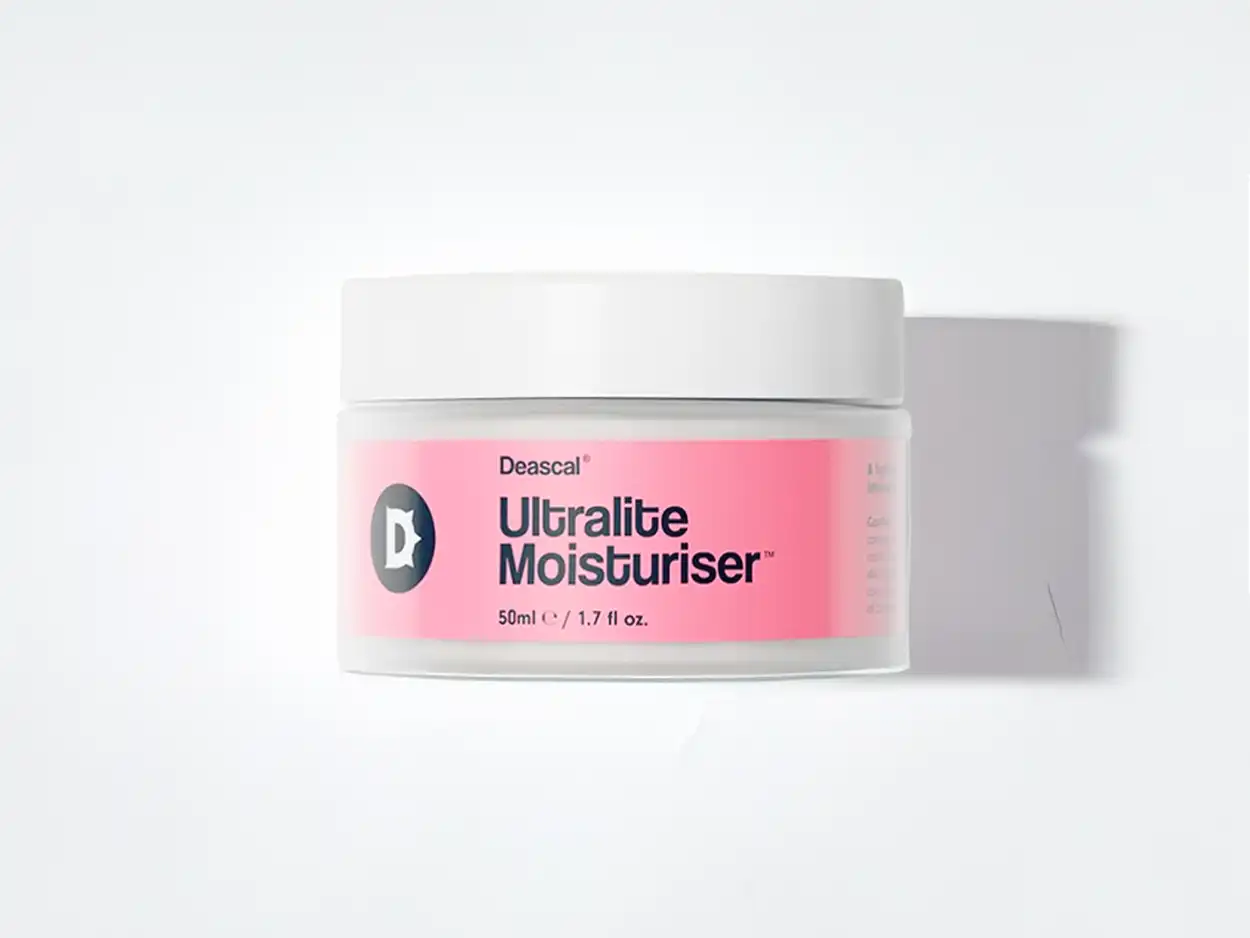

Deascal may not yet be the sort of skincare name that dominates every bathroom shelf, but it is quietly earning a reputation for thoughtful formulas that take hydration and barrier support seriously. With Ultralite Moisturiser, the brand is clearly aiming for “instant classic” status. The name might sound like it belongs on a piece of camping gear rather than a moisturiser, but it does get straight to the point: this is pitched as a featherlight daily hydrator that works hard without feeling like much of anything on the skin.
According to Deascal, Ultralite Moisturiser is a UK-made facial cream for all skin types and all ages that delivers fast-acting, long-lasting hydration while reinforcing the skin barrier, all with a weightless, non-greasy finish that suits everyday use. The brand highlights its Lightweight Hydration Diffusion Technology, a system that is meant to drive actives like hyaluronic acid, glycerin, ceramides, niacinamide and squalane deeper into the skin for both immediate comfort and compounding benefits over time.
In a skincare world crowded with big promises, social media hype and formulas that often feel more marketing than substance, it makes sense to look past the buzzwords. That is exactly why I spent 5 whole weeks using Ultralite Moisturiser consistently to see how it actually performs in real life and whether it deserves a place in your routine and your budget.
What is Ultralite Moisturiser?
Ultralite Moisturiser from Deascal is a facial cream designed for daily use on all skin types and all ages. It is made in the UK and positioned as a straightforward hydrator that focuses on two main jobs: keeping the skin comfortably moisturised and supporting the skin’s natural barrier. The brand describes it as fast absorbing and non greasy, with a finish that is meant to feel weightless on the skin rather than thick or occlusive. In practical terms, it is intended to be something you can apply in the morning or evening without it interfering with makeup or making the skin feel coated.
This product sits firmly in the “lightweight moisturiser” category. That simply means it is a cream that provides hydration and barrier support without the heaviness you might associate with richer or more occlusive formulas. Lightweight moisturisers tend to suit people who dislike any feeling of residue on the skin, those with oilier or combination skin who still need hydration, and anyone who wants a moisturiser that layers easily with serums and sunscreen. The idea is to deliver water binding ingredients and barrier friendly components in a way that feels almost undetectable once it has absorbed.
Deascal describes Ultralite as using what it calls Lightweight Hydration Diffusion Technology to carry familiar skincare ingredients such as hyaluronic acid, glycerin, ceramides, niacinamide and squalane into the skin. The claim is that this helps provide an immediate hit of moisture along with longer lasting comfort over the course of the day, while also reinforcing the skin’s barrier when used consistently. In theory, that should make it suitable as a single everyday moisturiser for simple routines or as the hydrating step within a more layered regimen.
Did it work?
To give Ultralite a fair shot, I actually stopped using my usual lightweight moisturiser for a few days and let my skin settle into a very basic routine. Very scientific of me, I know! Then I swapped in Ultralite as my only moisturiser for five full weeks, which I think is a solid amount of time to see what a product can really do rather than judging it off a single weekend.
From the very first use, it had that rare “oh, this is good” moment. I used roughly a pea-sized amount in the morning after a gentle cleanser and whatever serum I was testing that week, then a similar amount again at night. It spread effortlessly and within seconds it seemed to disappear, but my skin did not feel bare. Instead it felt cushioned and calm, as if it had quietly drunk a big glass of water. There was no tackiness, no slip and crucially no oily sheen, even across my T-zone which is usually the first place to complain.
The immediate hydration claim is absolutely accurate. On days when my skin felt tight from central heating and a lot of screen time, Ultralite took away that papery feeling almost instantly. Make-up went on smoothly over the top without pilling or patchiness, which is often where lightweight creams can fall apart. By lunchtime I would usually expect at least a hint of dryness or that urge to mist my face, but my skin still felt comfortable and quietly hydrated.
What really impressed me though was how consistent it was. Week one was all about comfort and that weightless feel. By week two I noticed that my cheeks, which are slightly drier and more prone to redness, looked more even and less reactive. I could use my usual exfoliating acid once or twice a week without getting the tight, over-stripped sensation I sometimes battle. It genuinely felt like my barrier was less fragile and more forgiving.
By week three and four the cumulative benefits started to show in a more obvious way. My skin texture felt smoother when I ran my fingers across my cheeks and forehead, and there was a soft, hydrated sheen that did not cross into shine. On mornings after a poor night’s sleep, my face still looked reasonably fresh and not as deflated or dull as it normally would. I also found I could get away with fewer hydrating serums underneath because Ultralite seemed to be doing the heavy lifting on that front.
Oil balance was another pleasant surprise. Although this is pitched as suitable for all skin types, I half expected my T-zone to get a bit slippery by mid-afternoon. It never really did. Ultralite managed that neat trick of making my skin feel genuinely moisturised yet not encouraging extra oil. On the flip side, my drier areas did not start to feel tight as the day went on. It walked that line beautifully which is rare.
By the end of the five weeks my skin simply looked healthier. It had that well rested, well hydrated look that usually only happens for me on holiday when I am sleeping more and spending less time under office lighting. Redness around my nose and on my cheeks was noticeably toned down and my skin tone looked more even in general. Friends who know nothing about skincare asked what I was using which is always the real test.
If I had to nitpick, I would say that on the coldest nights I occasionally layered a separate richer product just over the highest points of my cheeks, more out of habit than necessity. Ultralite is truly lightweight, so if you are used to very thick creams you might have a small mental adjustment period where you wonder if something this airy can really be enough. Within a few days, that doubt faded because my skin did not give me any reason to worry.
Taking everything into account, Ultralite not only lived up to its claims, it quietly exceeded them. It delivered instant comfort, kept my skin steadily hydrated through long days, helped my barrier feel more resilient and did all of this while feeling practically invisible on my face. In my experience it absolutely worked and then some, and easily earns its place as a standout everyday moisturiser.
Ultralite Moisturiser’s main ingredients explained
One of the reasons Ultralite performs as well as it does is that the ingredient list leans on proven, unflashy workhorses rather than gimmicks. At the base you have glycerin and sodium hyaluronate (the salt form of hyaluronic acid), which together handle that instant hydration hit. Glycerin is a classic humectant that pulls water into the upper layers of the skin and helps keep it there, so skin feels plumper and more elastic through the day instead of tight and papery by lunchtime. Sodium hyaluronate does a similar job but can sit a little deeper in the skin, creating that cushioned, bouncy feel that showed up for me around the second week of use. In practice these two are doing the heavy lifting on that “my face just drank a glass of water” effect you notice straight after application.
Supporting that are ceramide-like lipids in the form of sphingolipids and phospholipids. These are structurally similar to the lipids that naturally make up your skin barrier, so they help patch up tiny cracks in that barrier and reduce moisture loss. When your barrier is supported, you are less likely to experience stinging from actives, flare ups from cold weather or that persistent redness that never quite settles. I suspect this is a big part of why my cheeks became less reactive over time and why exfoliating acids felt more forgiving while I was using Ultralite regularly.
Niacinamide is another quiet star in the formula. It is a multitasker that supports the skin barrier, helps regulate oil, softens the look of enlarged pores and over time can even help with uneven tone and dullness. At the levels typically used in moisturisers like this, niacinamide tends to be well tolerated and brings that “my skin just looks healthier and more refined” quality rather than a dramatic overnight change. Based on the improved evenness and calmness I saw by weeks three and four, the inclusion of niacinamide here feels both thoughtful and effective, particularly if you want a single product to do more than just hydrate.
Jojoba seed oil is the main oil component and it is a smart choice for a lightweight moisturiser. Jojoba’s structure is very similar to the skin’s own sebum, which means it can help balance oil production rather than smothering the skin. It provides slip and softness without that heavy, greasy film that can sit on top of the face. Jojoba is also known to be soothing, which lines up with the reduction in redness and the general sense of calm my skin had, even on days when central heating and screen time were working against it.
Alongside these headline actives, the texture is built with familiar cosmetic ingredients like glyceryl stearate, PEG-100 stearate and cetearyl alcohol. These give the cream its smooth, non greasy feel and help keep the water and oil components blended. Cetearyl alcohol often sounds scary if you have been conditioned to fear all alcohol in skincare, but it is a fatty, non drying type that is widely used as an emollient and thickener. None of these are glamorous, but they are part of the reason the formula feels so weightless while still being properly moisturising. The fragrance is soft and did not irritate my skin, although anyone extremely sensitive to fragrance may want to patch test first, especially as it contains common fragrance components like linalool, limonene, hexyl cinnamic aldehyde, citronellol and benzyl benzoate.
In terms of suitability, the formula appears to be free from animal derived ingredients, which should make it a good option for both vegetarians and vegans, although strictly ingredient conscious readers may still want to check directly with the brand for confirmation about sourcing and manufacturing practices. None of the key ingredients here are known to be highly comedogenic, which means they are not likely to clog pores for most people. Jojoba in particular is often used in products for acne prone skin because it mimics natural sebum rather than overwhelming it. That said, comedogenicity can vary a bit from person to person, so if you are extremely breakout prone it is still wise to introduce any new moisturiser gradually and pay attention to how your skin responds.
For pregnancy and breastfeeding, the ingredient list does not contain any of the big red flag actives that are widely advised against, like retinoids or high strength salicylic acid. On paper that makes Ultralite look like a relatively low risk option. However, skin can become more reactive and unpredictable during pregnancy, and guidelines can differ from one practitioner to another, so I would always err on the side of caution and speak to your doctor or midwife before introducing or continuing any skincare product, including this one. A simple moisturiser can still interact with already sensitised skin, so professional guidance is sensible.
Overall, Ultralite reads like a formula built to quietly support the skin’s own systems rather than overwhelm it. The mix of humectants, barrier lipids, balancing oils and a gentle multitasker like niacinamide is clearly designed to deliver that immediate hydrated comfort, then compound those benefits over weeks so the barrier is stronger and the texture looks smoother. There are no trendy, hard to pronounce plant extracts thrown in just for a marketing story, and the absence of parabens and sulfates will reassure those who prefer to avoid them.
What I liked/didn’t like
To keep things simple, here is what stood out for me on both the plus and minus sides.
What works well:
- Genuinely weightless feel on the skin with no greasiness or tackiness, even on a warm or long day.
- Immediate and long lasting hydration that keeps skin comfortable from morning through to evening without needing top ups.
- Visible improvement in skin health over time, including calmer redness, smoother texture and a more even, quietly radiant tone.
- Balances oil well so that combination areas do not get shiny while drier areas stay soft and cushioned.
- Works seamlessly under makeup and other skincare steps, so it fits easily into both simple and more layered routines.
- Formula built around proven, skin friendly ingredients that focus on hydration and barrier support rather than gimmicks.
What to consider:
- If you love a very rich, cocooning cream, this ultra lightweight texture may feel a little too subtle on the coldest or driest days unless you pair it with an extra layer.
My final thoughts
Finding a genuinely good lightweight moisturiser matters more than it sounds, especially if you want skin that feels comfortable all day without that suffocated, coated feeling. I have tested my way through plenty of so-called “ultra light” formulas over the years, from high street to high end, and many of them either vanish into nothing or secretly behave like a rich night cream in disguise. That is why I made sure to give Ultralite a proper five week run, morning and night, before making up my mind.
After that stretch, I can say Ultralite lives up to most of its confident claims. The talk of Lightweight Hydration Diffusion Technology might sound a bit sci-fi, but behind the trademarked language the performance is very real. It hydrates fast, keeps skin comfortable over long days and quietly strengthens the barrier so skin just behaves better. There is no drama, no tingling, no need to baby your face around it. It simply does its job in a very reliable way.
In terms of who it suits, I think Ultralite is ideal if you have normal, combination or mildly dry skin and want something that feels like almost nothing yet still delivers proper hydration. It is especially good if you layer serums, wear makeup or just hate feeling like you are wearing skincare. If you are prone to redness or your barrier tends to sulk every time you introduce a new active, this kind of steady, barrier friendly moisture step can make everything else in your routine easier to tolerate.
On the other hand, if your skin is extremely dry, chronically flaky or you love the feel of a deeply occlusive, rich cream at night, Ultralite on its own may not fully hit that comforting, heavy-duty mark on the harshest days. You can absolutely use it as a base then add something richer over your driest zones, but if you only enjoy skincare that feels very plush on application, this texture might feel too restrained for your taste.
Personally, I was impressed. It is rare for a moisturiser to genuinely disappear on the skin yet still leave it looking calmer, smoother and more even week after week. The fact that it did all of that without a single breakout or flare up during the five weeks of testing earns it serious credit. For an everyday, all-round lightweight moisturiser that respects the skin barrier instead of fighting it, Ultralite is one of the best I have used, and for me it is an easy 5-star product.